The Lost Month

Things have been silent here on the site throughout August, which was something I didn’t intend.  So my apologies for the unplanned absence; not a good way to build an audience, is it?

This past month has seen a lot of little incidents – and a couple not-so-little ones – that hit me in many areas of my life and with such rapidity that what confidence I had was quickly overrun, and my anxiety and depression ruled the day for a while.  I can’t say I’m over it now – I still feel pretty terrible and still have some problems I need to solve – but I’m at least at a point where I can start thinking about moving forward again, with this site and with my life.  Which brings me to two announcements I’d hoped to give before now.

The first is, after careful consideration, I’m discontinuing the “From My Library” section.  Writing these reviews has primarily served to remind me why I don’t write reviews on a regular basis.  I think it takes a special kind of person to review stuff even part-time, one with more energy and self-discipline than I currently possess.  Better to spend my energy and build my self-discipline in other areas.  

The second is that there will be some layout changes coming to this site.  I’d used the Twenty-Seventeen theme to set the basic layout, but while it served its purpose at launch, I’ve found it a little too blog-centric, especially since I have plans for the gallery and to add stories in different media to the site.  Hopefully the new Gutenberg editor system that WordPress is setting up will give me more flexibility in changing my layout or even designing my own themes.  But you can expect the look and navigation of this site to change over the coming months.  

As well as new content – as I’m continuing to recover from my recent depressive bout, content will still be slow in arriving, but I’m committed to developing this site as a place where people can see what my imagination can deliver.  There will be more art, stories, and other stuff for you soon.

In all, thanks to everyone for sticking with my for these first three months.  As we move forward, I hope you’ll like what I have to bring to the site.
Blishful Thinking

Because so much science fiction is set in The Future, its easy for people to think it’s job is to try to predict the future.  Lots of people have written on this subject (usually in the vein of “prediction is not the job of science fiction”), so I don’t really have a lot to add to the subject.

Except, to note that, every so often, one gets a lineup between fiction and reality that is so close its uncanny.  In this case, it’s the novel They Shall Have Stars, written by James Blish back in 1956.

They Shall Have Stars was the first book of Blish’s “Cities in Flight” series, a future history where a device known as the “spindizzy” allows for people to leave the Earth and travel the universe by turning whole cities into ad-hoc starships.  At the time the spindizzy was invented, the Cold War had gone on long enough that the United States had turned itself into a reasonable facsimile of the Soviet Union, with secret police, massive censorship, restriction of knowledge, and stagnation of scientific progress.  With both sides in the Cold War now so much alike, a Soviet victory was inevitable (and indeed, in the ensuing future history, the resulting US-Soviet merger into a world-state is listed as the Cold Peace).  The Alaskan Senator Bliss Wagoner decides that if the West is doomed, at least its ideals must live on – and so he backs pursuit of various fringe science theories.  In the end, he’s arrested by the FBI and executed, but by then its too late: the spindizzy proved successful, allowing for dissidents and malcontents to flee the Soviet world state for life among the stars.

The year this takes place?  2018.

Now, obviously, we’re nowhere near the development of easy interstellar travel.  Spindizzies and warp drives remain far from practical application, though they no longer seem impossible.   But so much of the political backdrop for the novel seems as if its lifted from today’s headlines.  Restriction of Western freedoms?  Check.  Soviet (well, Russian) meddling in Western affairs, especially elections?  Check.  American Secret Police?  Check – though its not the FBI, but rather Homeland Security and ICE.

Of course, the battle for the American soul is still being waged (though the Midterm elections might give us a good idea on how it will turn out) so we might still avoid the Cold Peace for something much happier.  But Blish’s big concept here was recognizing that society needs escape hatches – ways for people to flee if all else seems lost.  In the book, the spindizzy provides the means, and other planets the refuge.  Modern spaceflight is not quite up to the task, but we’re closer to building colonies on other planets now than we’ve been before.  If there are to be refuges from totalitarianism, Mars or the Moon just might be viable options.

Some forty years after They Shall Have Stars was published, Carl Sagan had similar thoughts, though his concern was more about threats to human survival.  In his book Pale Blue Dot, he writes: “The more of us beyond the Earth, the greater the diversity of worlds we inhabit, the more varied the planetary engineering, the greater the range of societal standards and values – then the safer the human species will be.”  I would add, the freer we will be, too.

For now, though, our options to preserve our rights and freedoms remain fairly open.  But let’s also keep an eye out for our “Bliss Wagoner”… just in case.

From My Library – Postponed to August 21

It’s with regret that I have to cancel this month’s From My Library column.   Selecting Young Miles was the book for review proved to be too troublesome to work with for two reasons:

First, it was three books in one, which was quite a hurdle in itself, and:

Second, those books went to some really dark places.  Which, given the continued waking-nightmare of modern society, proved too much for me to process, much less write about semi-intelligently.

My apologies to my readers.  I’ll have a new From My Library column, on a different book, on August 21.


Canada Day 2018

I would like to take this time to wish all my Canadian visitors a happy Canada Day!  Our nation is 151 years old today, and may I say it looks well for its age.

We have a lot of good things going for us here, but in between the BBQs and fireworks I’d like us to pause and reflect on the fact that our nation is not perfect.  We still have inequalities within our borders, between races, language groups, genders and gender orientations.  We’ve made progress in all of these areas, making Canada a better place for everyone, but we still have a long way to go.  And we must always be mindful that there are people who want us to halt our progress and return to more repressive and cruel ways.

Our civil rights, as enshrined in the Canadian Charter of Rights and Freedoms, are not immutable laws of nature, but are rather privileges, agreed upon by the majority, and they can be just as easily taken away.  Our American neighbours are learning this painful lesson right now, as an increasingly fascist government consolidates its power and punishes the weakest and most vulnerable for the crime of existing.  We must remember that there are proto-fascists within our own nation, who dream of doing the same thing here.

The last Conservative government used nationalism as one of its rallying cries, and in 2015 ran the most racist election campaign I’d had the displeasure of seeing.  Worse, they almost won on the strength of their racism.  We need to remember how close we came to following America’s spiral into the abyss.   We could still go that way, in the next election or the one after that.

So today, let us resolve to be kind to each other regardless of race or language or religion or gender or orientation.  Let us help the cause of justice where we can, with the gifts we possess.  Let us welcome those who come to our land seeking safe refuge.  Let us remember to vote, every election, and to carefully consider our vote, for evil’s best ally is not the fascist but the apathetic and the ignorant.

Happy Canada Day.  May the true north remain strong and free.

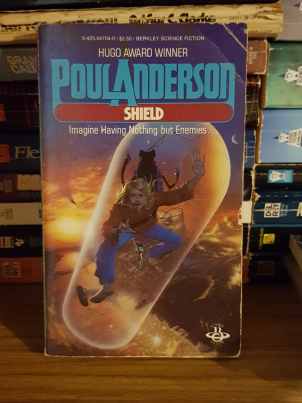
From My Library: Shield by Poul Anderson

My first encounter with Poul Anderson was in an anthology entitled “Space Odyssey”, published by Octopus Books, back when I was still in grade school.  It held Anderson’s short story “Ghetto”, a tale of racial prejudice applied to a far-future society, a tale I’ve come to appreciate more in the present day than when I was a kid.  But even as a child, Poul Anderson’s writing came alive to me in a way that other writers did not.

Poul Anderson was one of the grander storytellers of 20th Century science fiction, adept at both “thud-and-blunder” action as well as ruminating on deeper themes.  Shield, first published in 1963, sits near Anderson’s earlier career, and is a good, well-paced read that seems scarily prescient in light the path the United States has taken in recent decades.  

Shield tells the story of Peter Koskinen, a naive 23-year old engineer and astronaut just back from an expedition to Mars.  Peter has in his possession a device he built with the help of the ancient Martians his expedition found and befriended; a “potential barrier” capable of stopping almost all weapons – the shield of the title.  Unfortunately, Peter lives in a world governed by the Protectorate; the name given to the United States’ effort to rule the world by force and puppet governments (sound familiar?).  In this world, the most powerful person is not the President, but the Director of Military Security, and even American citizens are spied on and arrested by MS if there is even a hint of a threat to American interests.  News of the shield’s existence reaches both MS Director Marcus and various opposing factions, and in short order Peter finds himself on the run from everyone, as it becomes clear that all factions would happily kill him to get their hands on the shield. 
Continue reading “From My Library: Shield by Poul Anderson”