
My first encounter with Poul Anderson was in an anthology entitled “Space Odyssey”, published by Octopus Books, back when I was still in grade school. It held Anderson’s short story “Ghetto”, a tale of racial prejudice applied to a far-future society, a tale I’ve come to appreciate more in the present day than when I was a kid. But even as a child, Poul Anderson’s writing came alive to me in a way that other writers did not.
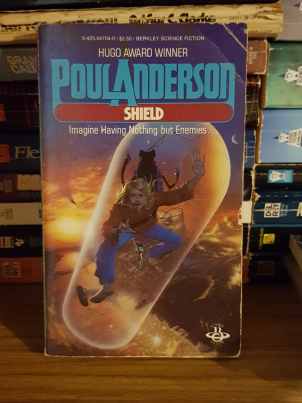
Poul Anderson was one of the grander storytellers of 20th Century science fiction, adept at both “thud-and-blunder” action as well as ruminating on deeper themes. Shield, first published in 1963, sits near Anderson’s earlier career, and is a good, well-paced read that seems scarily prescient in light the path the United States has taken in recent decades.
Shield tells the story of Peter Koskinen, a naive 23-year old engineer and astronaut just back from an expedition to Mars. Peter has in his possession a device he built with the help of the ancient Martians his expedition found and befriended; a “potential barrier” capable of stopping almost all weapons – the shield of the title. Unfortunately, Peter lives in a world governed by the Protectorate; the name given to the United States’ effort to rule the world by force and puppet governments (sound familiar?). In this world, the most powerful person is not the President, but the Director of Military Security, and even American citizens are spied on and arrested by MS if there is even a hint of a threat to American interests. News of the shield’s existence reaches both MS Director Marcus and various opposing factions, and in short order Peter finds himself on the run from everyone, as it becomes clear that all factions would happily kill him to get their hands on the shield.
His only allies are Vivienne Cordeiro, a smart and technically-oriented girl who helps Peter escape from a brutal crime lord, and Jan Trembecki, a security chief for a major businessman with a sense of ethics and morals (which seems fairly quaint, given the shape of modern capitalism, but I digress). Through them, Peter gets a much-needed education into how the world really works, and with their help, he escapes the traps some of the factions lay for him, though not without great cost. In the end, Peter does not so much as triumph as he takes away the chance of an easy victory from any faction – by making the shield available to everyone. In doing so, Peter puts his faith in the common man, and in the hope that there are more decent people than power-hungry ones.
Anderson’s writing carries the reader through the story easily; the story only really slows down – but never stops – when the characters stop to talk politics. Even those discussions remain on-point for the story, befitting the education of the characters, and helping to advance the plot.
Still, the story is not without its issues. The final confrontation between Peter and MS Director Marcus seems to wrap up a little too quickly and neatly, with the US Air Force acting as the calvary coming to the rescue. Marcus might be the most powerful person in this future-US, but he’s not the only one with power, and others come to the fore somewhat rapidly, with very little foreshadowing that such an avenue was possible. Also, the character of Vivienne, who has been fiercely independent since her escape from her crime-lord “boss”, gets a little too passive during the story’s climax. Amid a time when most woman characters were more prizes to be won or damsels to be saved than actual people, Vivienne was a rare exception. She is not so much willing to let others save her as she is to take what opportunities she has to save herself. Her retreat into a more “traditional” role seems out of character for her, though she gets some of that back, when she decides to part ways with Peter in the end.
Finally, especially to the reader that is savvy with social media and at least knows about Wikileaks, I suspect Peter’s effort to distribute the shield’s plans via videophone seem both needlessly convoluted and naively optimistic. But, I don’t think we can blame Poul Anderson for not predicting the internet, social media, or the AI algorithms that “curate” (censor) what content we get through those channels.
Shield has not been in print for some time, nor has it been republished electronically, so chances are the only place people can find this book will either be in public libraries or in used book stores. As it happens, that’s where I found this book. You’ll have to decide for yourself if its worth the effort to hunt down, but I believe it’s still worth reading.
Next time, we’ll have a look at an entry from one of the more popular space opera series around. Lois McMaster Bujold’s Young Miles, coming July 17.